

Permanent exhibition in the tower Kiek in de Kök
The permanent exhibition in the Kiek in de Kök tower is aimed to give the visitor an overview about the birth of the town, the history of its fortifications and main military campaigns and sieges from the 13th to the 18th century.
The scheme of the setup of the permanent exhibition is available on the interactive screen right next to the entrance to the tower part of the museum, where a visitor is greeted by a statue of a Swedish mercenary.
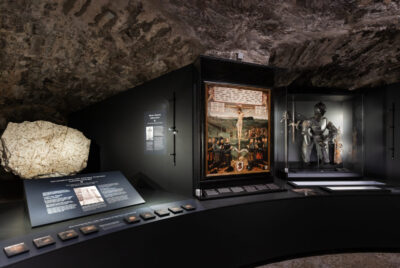
The ground floor and the first floor of the tower, historically used respectively as the storage space and the lower defence floor, house the Permanent exhibition on the Blackhead brotherhood mercantile guild. Visitors start from the first floor and it is up to them, whether they wish to descend down to the ground floor to see an exhibition on the topic of their voluntarily firefighters brigade an parade duties. Heading up from the first floor to the second, a visitor can opt whether to use the modern staircase or the original winding stone staircase for more authentic experience. The original stone staircase passes by an ancient privy facility called ‘dansker’, while the modern staircase landing has an access to the wall-walk leading to the adjacent Neitsitorn(Maiden) tower. The wall-walk with a picturesque view
to the Old Town is open from 11 til 17:45 and accessible for visitors who have purchased a ticket to the four towers or to the entire museum.
Back in the 16th and 17th cc, the frontrunners of the city defence were the members of the prominent Brotherhood of Black Heads (Bruderschaft der Schwarzhäupter), a military organisation back then with a motto ‘Aut vincendum aut moriendum’ (to conquer or to die), and so a visitor can learn about their role in the city defence. The famous painted epitaph made by Lambert Glandorf in 1561 commemorates the Black Head brothers who were killed defending Reval against Russian troops (so-called Moscovites back then) on 11th September 1560 in the Battle of the Jerusalem Hill. The epitaph gives a fascinating glimpse to the city skyline and layout back in the 16th century.
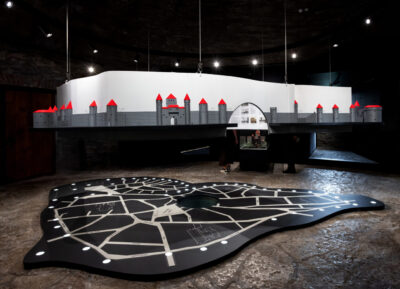 The second floor is where the permanent exhibition continues. Historians believe that the predecessor of the stronghold on Toompea Hill, was the Iru hill fort, abandoned around the turn of the 10th and 11th centuries. During the time, the Iru hill fort was abandoned, a stronghold was built on the limestone rise of Toompea and a settlement likely appeared at its foot. The archaeological finds from the Late Iron Age give a glimpse of the early days of the city.
Other items on display on the second floor inform the visitor of medieval defences, walls, towers, and gates. The layout of the Reval city defensive wall and models of all of its towers sprawling across the middle of the floor and hanging from the ceiling. Next to the model showing the placement of towers, visitor can find a glass display case with the model of medieval Harju gate of Reval.
There are several interactive displays depicting Tallinn fortifications in art. Also on the same floor, there are 4 ‘hands on’ puzzles for all ages , focusing on the theme of city defences.
Being seated on the padded bench, a visitor is invited to rest their legs, while watching a film about the history of the city in the ‘Film cave’. The film is available in Estonian, Russian, and English, and is activated by the press of a button.
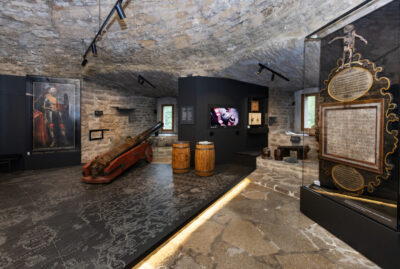 The third floor display is dedicated to the cannons and armors for Reval (Tallinn). A visitor can take a close look at four big weapons: two cannons from 1559 and 1560 named respectively the Lion and the Bitter Death, and a breach loading guns from early 15th century. All these artillery guns are exact replicas as the originals were taken to St. Peterburg in 19th century and never returned.
The original cannons were made by local masters, the Lion by Karsten Middeldorp in 1559, and the Bitter Death by Kort Hartmann in 1560. Reval weapon masters were famed and praised, and so the muzzle loading guns are a perfect example of the exquisite skill and taste of the local masters. The Lion bears an image of a lion and both coats of arms of Reval help up by gryphons. Beneath the coats of arms a verse has been inscribed relating: ‘The Reval Town Council nam’d me The Lion / to destroyeth all enemies dishonouring peace/ in the year 1559 Karsten Middeldorp didst cast me/ and this is the whole sooth’.
Five ‘hands on’ exhibits are spread out on the third floor. On the wall hang two cannon balls visitors can gauge the weight of, one made of metal and the other hewed from stone. The second intractable exhibit is a barrel with block to find the concistency of gunpowder. Right next to it you get to try on medieval amour to gauge their weight and texture. There is a medieval life of a merchant ‘boardgame’ mounted on the wall, which has an electronic button activated dice next to it. And lastly there are paraphernalia relating to the loading of a cannon.
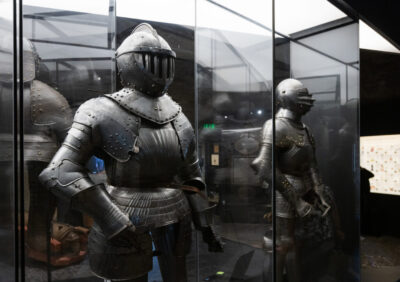
The glass display cases showcase armour of the fighting sides. The coat of arms of rulers of the period remind us of the battles and sieges taking place during the Livonian War, taking place from 1558 to 1583, when armies of various kingdoms – Denmark, Norway, Sweden, Poland, Lithuania, and Russia – were fighting over the territory of Old Livonia (present day Estonia and Latvia).
Before or after the visit, a visitor can look up to take a look at the south side of the tower from outside and see the stone cannon balls walled in. These are the authentic cannon balls shot at the Kiek in de Kök battery tower from the cannons belonging to the troops of the Russian Tzar Ivan the Terrible during the siege in January-March 1577; as the gaping holes in the side of the tower were repaired after the siege, the cannon balls were walled in as a reminder.
This floor has two films of the history of sieges and wars involving Reval (Tallinn), the second of which is focusing on 20th century. The films are available in Estonian, Russian, and English, and again, The films are activated by the buttons at the lower end of the screen. Part of the exhibition reminds us that in addition to battles and sieges, famine and plagues were also frequent visitors and had its impact on the history of the city.
There is a third film that instructs the viewer on the process of loading a cannon.
The original stone plaque epitaph on a side of embrasure is made by famous Dutch stone carver and architect Arent Passer (1560 – 1637) and dedicated to the victims of the 1602-03 famine and plague of Reval. The verse woefully describes the horrors of such plague, and can be translated as:
The year one thousand and six hundr’d two / ov’r h’re in Livonia ev’ryone shall rememb’r / f’r many of us our earthly journey cameth to an endeth / at which hour the war, famine and foul pestilence wast running riot. / A sir wast eating his broth’r because of famine / and wast consuming cats and dogs.
In 1697 the original stone plaque was framed in carved wood border, crowned with a small skeleton. Under the skeleton an inscription promises: “He… shall cure all the woes” and above the stone tablet the writing cautions:
Read, traveller, from this stone, what wicked fate / has stricken us two years past 600. / When the century ended, thousands were dying / over again, upon whom the famine had befallen.
The German verse reminds us that we should not forget about the poor. And the lower oval under the stone tablet is explaining in German: ‘In the year 1697, when in the same way, like in the year mentioned above, an indescribable famine sent by God has befallen upon us killing thousands, this stone tablet has been found and unearthed by Christoffer Schwabe, the governor of the almshouse, and put on display again to be remembered eternally.’
The modern stairs end at the third floor. In order to continue to the fourth floor, the visitor has to ascend the winding stone staircase that can be accessed from the floor or the landing on the top of the modern staircase. There is a small kitchen hidden between the two staircases, displaying what the kitchens looked like centuries ago, and especially children tend to be enthusiastic about the turn roast on the fire pit.
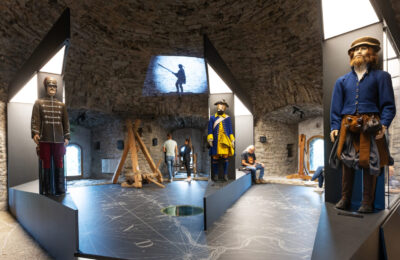 The fourth floor of the tower has been divided internally into two levels and has a uniform theme — it is a dedicated Armoury Chamber where the arms and some armament from the collection of the Tallinn City Museum is showcased in glass display boxes. There are armour and swords and shootings guns that were used before the advent of the firearms, back in 13 and 14 century. Multiple firearms from the 15th to the 20th century form a major part of the display.
Three mannequins showcase the different types of armour an estonian would have been wearing in the Livonian war, The Northern war and The First World War. Behind each uniform there are displays of weapons from the appropriate era. Two identical booklets are located on the ledges of the display cases, which have hand drawn illustrations and information about the displayed weaponry.
On this floor there is a children’s activity corner and a place to rest. As well and two ‘hands on’ exhibits focusing on dueling with a sword, and another for shooting a pistol.
A projection on the ceiling shows the development of weaponry via shadow theatre medium.
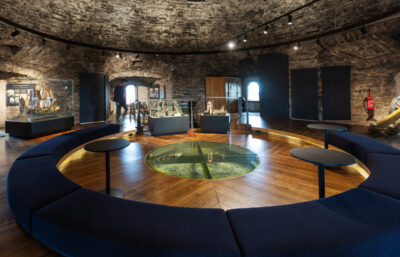 The fifth floor is the highest floor of the tower and is used for temporary exhibitions and special events. As there are seats available, it gives the chance for a visitor to rest their legs.
Perhaps the biggest permanent attraction of the floor is the magnificent, postcard-like view opening through the embrasures to all directions. There is also a toilet on that floor. So the top floor gives a visitor a chance to see the temporary exhibition, admire or take photos of the views, and recuperate a bit before starting to descend the narrow winding stone staircase.
We no longer have a café on that floor.
On display is a replica model of the new earthwork fortifications of the city from the 17th century. The original model is located in the Swedish Army Museum in Stockholm, Sweden.